Serverless and Managed Services
You did not remove the operational burden, you traded it for a different one — IAM, limits, and a cost curve that inverts.
The situation
Four services, two engineers, and no platform team. Running Kubernetes for this is absurd, and yet somebody still has to patch, scale, and wake up for whatever you do run.
The serverless style answers that by owning no long-lived compute: functions or managed containers scaled by the provider, state in managed services, glue made of queues and events. What you are buying is not “no operations” — it is a different operations surface, one that is mostly configuration.
graph TB
    W["Four services still have<br/>to run somewhere"] --> Q{"Who owns the<br/>operations surface?"}
    Q -->|"self-managed"| S["Patching, capacity planning,<br/>node pools, on-call for hosts"]
    Q -->|"serverless"| M["IAM grants, execution limits,<br/>event wiring, cost per request"]
    S --> N["Work you control"]
    M --> P["Constraints you do not"]
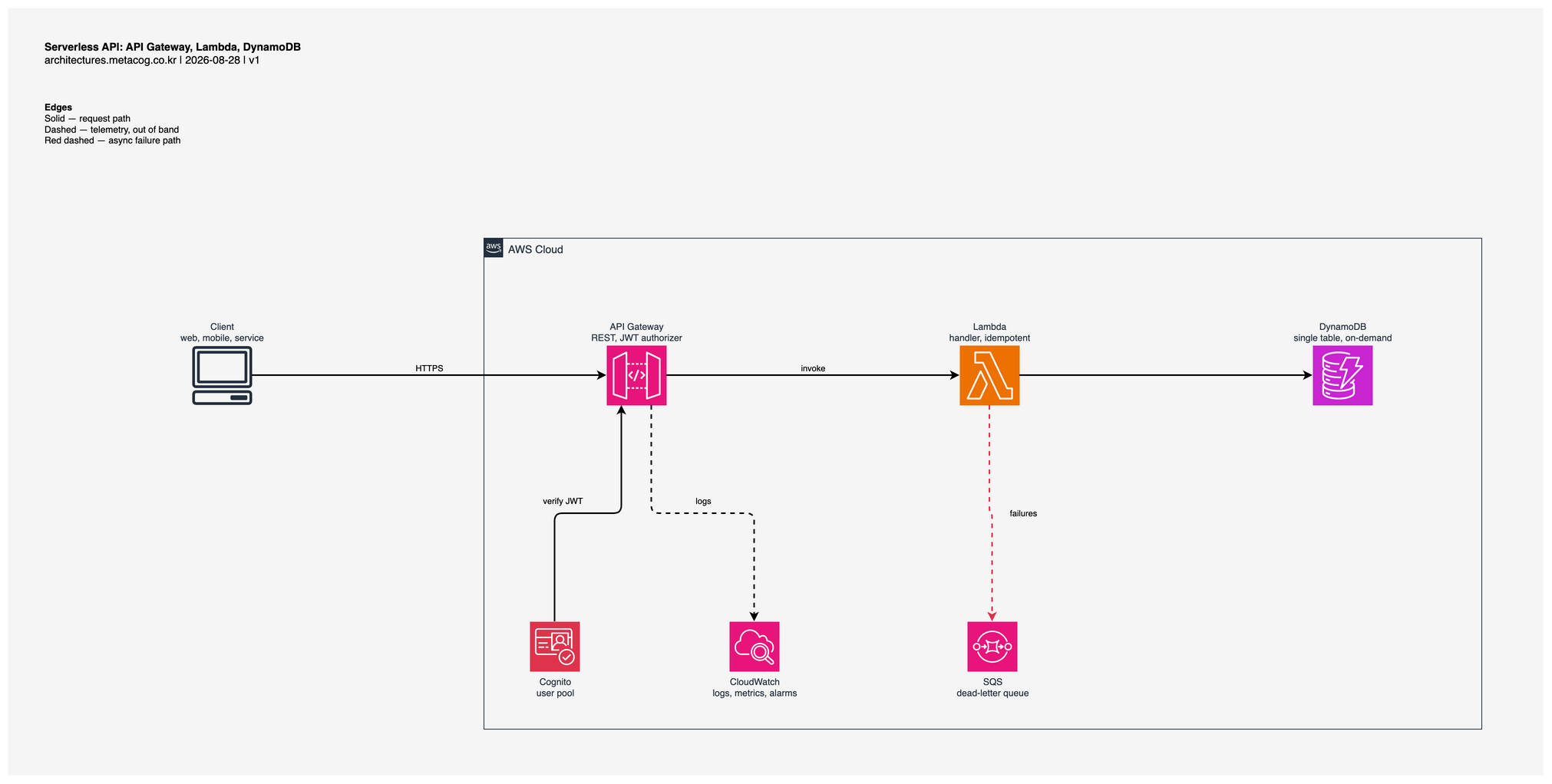
Concretely, on one provider, the smallest honest version of the style is this — note that Cognito, CloudWatch and the dead-letter queue are not extras, they are the configuration surface you just took ownership of:
What it genuinely buys
- No patching, no capacity planning, no node pool. The largest recurring ops cost for a small team simply goes away.
- Scale to zero, and up. Spiky and low-average workloads — internal tools, webhooks, batch triggers, admin backends — are dramatically cheaper, and idle environments cost nothing.
- A default security posture you did not have to build. Isolation and patching come from the provider. For a team with no security engineer this is a genuine step up.
- Small blast radius per unit. A failing function does not take down a host shared with three other things.
What it actually costs you to learn
These are the ones that bite in month three, not month one.
Execution limits shape the design. Timeouts, memory ceilings, payload sizes, and concurrency caps are architectural constraints, not configuration details. A job that grows past the timeout does not get a bigger box — it needs to be restructured into steps with checkpoints, or moved to a different runtime entirely. Design for that split before you discover it at 14 minutes 55 seconds.
Connections do not pool. Hundreds of concurrent function instances each opening a connection will exhaust a relational database that was sized for a handful of application servers. The answer is a connection proxy or an HTTP-based data API. This is the most common serverless production incident and it appears exactly when a launch goes well.
IAM becomes the architecture. Every interaction is a permission grant. Done well this is genuine least privilege — better than most VM estates ever achieve. Done in a hurry it is a wildcard policy copied from a blog post, and misconfiguration, not exploitation, is the dominant risk in this style. See Least Privilege and Auditability.
Local development is worse, permanently. Emulators drift from the real
platform in exactly the behaviours you care about — IAM, event shapes,
throttling. The honest answer is per-developer cloud environments and fast
deploys, which means investing in environment
tooling rather than pretending
localhost will do.
You are distributed by default. Even a small application becomes a set of functions, queues, and event rules. You inherit async debugging, retries, and partial failure — the microservices tax — without having chosen microservices or gained the organisational benefit that justifies it. Tracing is not optional here either.
The cost curve inverts. Per-request pricing is a bargain at low and spiky volume and expensive at sustained high throughput. There is a crossover point where a reserved instance is several times cheaper. Know roughly where yours is; it is arithmetic, not ideology, and the answer changes as you grow.
When the style is right
- Spiky, bursty, or low-average traffic. Anything triggered by events rather than by constant load.
- Glue: reacting to a webhook, moving a file, fanning out a notification, a scheduled job. This is the strongest case and it is not controversial.
- Small teams with no ops capacity, where the alternative is not a well-run platform but a badly-run one.
- Workloads with genuinely unpredictable scale, where over-provisioning is expensive and under-provisioning is an outage.
When the default is wrong
- Sustained high throughput. The cost crossover, plus you are paying a premium for elasticity you are not using.
- Tight, predictable latency budgets. Cold starts have improved a great deal and are still real for heavier runtimes and private-network attachment. A p99 requirement measured in tens of milliseconds is a hard fit.
- Long-running or stateful work. Streaming connections, big batch jobs, anything holding state in memory across requests. Fighting the model here costs more than a container would.
- Hard portability requirements. Not because functions are hard to rewrite — they are usually small — but because the composition is the application. Your queues, event rules, IAM policies and managed datastore semantics are the design, and none of that ports.
What it costs
Lock-in is at the seams, not the code. Rewriting the handlers is a week. Replacing the identity model, the event bus semantics, and the datastore’s consistency guarantees is a rewrite. Judge lock-in by how much of your design lives in provider configuration, not by how many lines are provider-specific.
Observability is the provider’s, and it is vendor-shaped. You get a lot for free and you get it in their vocabulary. Exporting to your own stack is possible and is another integration to own.
Cost becomes a per-request property of your code. A retry loop or an accidental fan-out is now a bill rather than a CPU graph. Budget alerts are not finance hygiene here, they are an outage-prevention control.
The limits are someone else’s roadmap. Quotas, regional availability, and deprecations move on the provider’s schedule. This is the real trade of the style: you exchanged work you controlled for constraints you do not.
See also
Last updated 28 Aug 2026, 00:00 UTC.